
As ever a warm welcome to the new issues of Youth & Policy and CONCEPT, both now available online. The articles in both are concerned with the present mess we are wading through and well worth your time and effort,
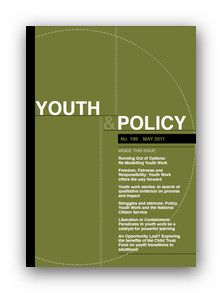
In Y&P Tony Jeffs gets the show on the road in his inimitable style. Pondering the incessant demand that youth work proves itself, his riposte is cutting.
Introduction – Running Out of Options: Re-Modelling Youth Work. Tony Jeffs
But what sticks in the craw is that amongst those baying for hard evidence that ‘youth work works’ are privileged individuals who have benefited from sustained contact, often over many years, with a wise and mature house master or mistress or college tutor; who it goes without saying, would never envisage such roles being occupied by short-term contract workers or rewarded via a payment by results system. They know from their own experiences that all that is taught and learnt cannot be measured. That is why they are willing to spend so much sending their own children to public schools and elite universities. Therefore it is legitimate to ask the question why they seek to deny those less privileged than themselves an opportunity to access a cut-price version of the informal education they enjoyed. If it is because they think those less rich than themselves must be denied anything but the thinnest educational gruel then they must say so; if it is in order to reduce their tax bill again they must say so; if it is to prevent the off-spring of the poor getting the jobs they think are the birth-right of their own children again they must say so.
In a slightly amended form these same questions need to be asked of high-paid public sector managers who rant on about ‘evidence based practice’ and ‘show me that informal education is important’ then spend a small fortune on activities, holidays, coaching and even counselling for their own children. The spending patterns of the rich and the managerial class provide all the evidence one needs that informal education and youth provision are important – much as a day wandering around a top public school or five minutes looking at the notice board of an Oxford college will do. Demands for evidence that such things are important for the less well-off members of our society carry more than a strong whiff of hypocrisy with them. The more generously inclined amongst us might view them as just a smoke-screen, a diversionary tactic. Whatever the judgement,those of us who cherish such things and believe in the liberatory potential of informal education,would be well advised to dismiss them as such.
Other pieces include:
Freedom, Fairness and Responsibility: Youth Work offers the way forward. Viv McKee
– following upon Tom Wylie’s argument, Youth Work in a Cold Climate, in Y&P 105, Viv pushes the case for a pragmatism, which ‘works’ against ‘grandstanding and soap-box campaigns’. For a sharp response to Tom Wylie’s caricature of ourselves as idealist romantics, see Bernard Davies on Critical Exchanges
Youth work stories: in search of qualitative evidence on process and impact. Bernard Davies
– ironically, given Tom’s charge that we are of an old-time religious persuasion, content to tell ‘heart-warming tales told of young brands plucked from the fire, of lives turned around’, Bernard on behalf of the IDYW Campaign contributes a group of stories of practice, complemented by an interrogation of their contradictions and significance. As it is we have been granted funding by UNISON and UNITE to produce an extended and developed version of this interaction of anecdote and analysis – more news soon.
Struggles and silences: Policy, Youth Work and the National Citizen Service. Tania de St Croix
– just as the Education Select Committee Inquiry questions the efficacy of Cameron’s hobby-horse, it is enlightening to read Tania’s scathing critique of its premise and intent.
Liberation or Containment: Paradoxes in youth work as a catalyst for powerful learning. Annette Coburn
– in a challenging piece rooted in conversations with young people Annette explores the paradox of containment and liberation within youth work, arguing for ‘a border crossing pedagogy’, which could engage with the increasing compromises made around the voluntary relationship.
An Opportunity Lost? Exploring the benefits of the Child Trust Fund on youth transitions to adulthood. Lee Gregory
– being pretty ignorant about the Child Trust fund and the notion of the ‘asset-effect‘ I’m still absorbing Lee’s argument.

The editorial begins:
This edition of Concept is full of „big ideas‟ – which turn out on closer inspection to be not so big at all. Indeed, whether the Big Society, „Happiness‟ or Community Engagement, the articles in this issue demonstrate how these warm, comforting-sounding policy ideas have a function of concealing the harsh reality of economic inequality and the impact, or even the implementation, of more significant policies which exacerbate this. Nonetheless, there are always opportunities in any policy climate to respond with critical educational action.
Articles include ;
The Big Society : What’s the Big Idea Mae Shaw
Reflections on community development, community engagement and community capacity building Gary Craig
Smiling through the Depression: the ‘Happiness’ Movement Iain Ferguson
The Attack on The Spirit Level Nigel Hewlett
Just in the middle of dipping into the contents, but yet again I’m struck by how the articles raise issues and dilemmas that need to be debated – so a reminder that our sister site Critical Exchanges is set up to stimulate discussion and we would love to post responses there to any of the above pieces.
 IN DEFENCE OF YOUTH WORK