
Kalbir and Nisha have sent this graphic and disturbing account of police harassment on June 30 in London. They pose some challenging questions for youth workers and everyone involved in building a movement of resistance to the austerity package.
When we reached the demonstration in Central London, we were glad to see so many school and university students had come out to support their teachers, lecturers and parents in a show of solidarity. Understandably, few had the stomach for the old trade union style meeting that was scheduled at the Methodist Hall in Westminster. Instead, the sunshine called on young people to make their solidarity felt through music, dance and the banners they’d made.
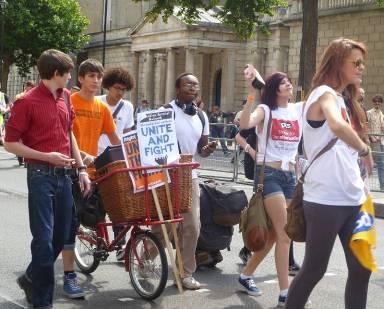

Unlike the first anti-tuition fees protest, police were in plentiful supply this time! The police were fishing for young people to pull out of the crowds. Some young men were targetted, snatched and taken to Charing Cross police station and others were taken from the crowd for a stop and search operation. Notably, the young people who were targeted happened to be wearing hoods, scarves or carrying rucksacks.
Some were issued with tickets after a lengthy and seemingly unnecessary search that identified them and what they were carrying. They were sometimes allowed to leave after the police had taken the individual’s details for the record. We came across one young black man who told us this was his second stop and search that afternoon!
Others were seized from crowds by specialist officers in soft baby blue caps carrying riot helmets on their belts.

Kettling has now been deemed illegitimate unless used as a last resort, but it was used in Whitehall on June 30th to stop groups of young people entering Trafalgar Square without being processed. The injustice in targetting young people was palpable and produced cries from the crowd of ‘shame on you’ against the police whenever a young person was taken.
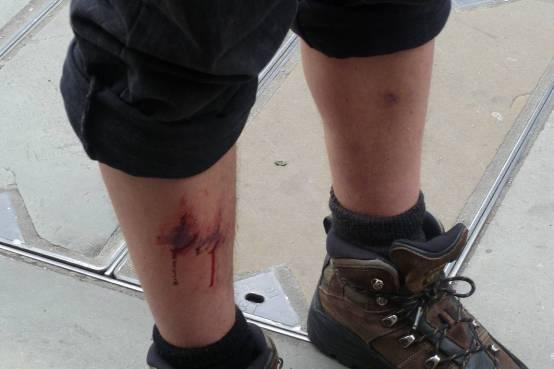
Surely the young people who were taken aside and those who had been arrested that day had committed a crime? No they hadn’t. For example, this young man pictured below told us he’d been wounded by officers when he ran to someone’s aid. The result of being brutally kicked by police boots is clear in the photo:
Then we got a phone call from a UCU member who we were expecting to meet at the protest. His teenage son had been taken to a police station ‘under suspicion’ that he might just, possibly commit criminal damage whilst on the protest. He had done nothing criminal but he is being charged on the basis of a suspected thought crime!
As youth workers and youth work trainers, we are all familiar with the use of ‘sus’ laws, particularly against young black men. On this demonstration, they were used against young people generally.
It was during the student fees protests that young people protesting against the current government’s austerity measures came to be criminalised. Once, you had to be a young black man or a young Asian man to be systematically stopped under suspicion. Now, just by exercising the right to protest a young person has become vulnerable to being put on a police database.


Trade unions and activists who want to broaden the protest movement and make it intergenerational need to identify how to defend young people who take to the streets. There is already a national campaign to ‘Defend the Right to Protest’ (www.defendtherighttoprotest.org) which proves that young people are working to exercise their rights to protest and are struggling to make their voices heard in the face of repressive policing.
Of course, we must support such campaigns. However, there is much to be done even before young people find themselves under arrest. After all, solidarity is a two way street – so when young people show solidarity with adults, adults must work with young people to put measures in place that ensure young people’s safety. Rights Cards are a great start but they are simply not enough to ensure young people’s safety. For example, one young person arrested on June 30th had his rights card whipped away from him by officers.
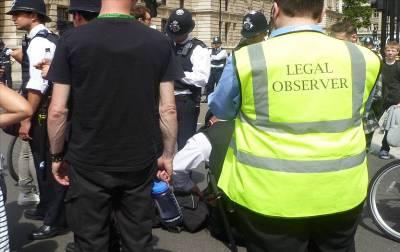
Proper safeguards are needed along with joint youth and adult stewarding. Organisers and unions must also refuse to accept that young people who protest are automatically potential criminals, even in the face of the media onslaught.
These have to be the basics of organising protests that take into account the vulnerability and capabilities of our young people. Unless we work with young people to put protective measures in place, we’re leaving young people at the mercy of a state that has declared an ideological offensive against them, minorities and the working class.
Kalbir Shukra (youth work lecturer) and Nisha (aged 14)
 IN DEFENCE OF YOUTH WORK