
Just a week ago I happened by chance to be chatting in a kafeneion to some Greek young people about their situation. The conversation somersaulted from description to explanation to the question of action – what can be done to change things? To say the least the outlook is bleak. The unemployment rate in April for 15-24 year olds reached a high of 43.1%, compared to the national rate at 15.8%. Three of my four young friends held degree-level qualifications and joked that they were the stars of the popular sit-com, The 592 Euro Generation, a reference to the monthly minimum wage of €592 (£516) earned by those under 25. They chided me that I had not caught up with this satire which reflected their reality, serving coffee to tourists, their qualifications irrelevant. The discussion turned to political protest. Everyone argued about the merits or otherwise of orchestrated demonstrations under the control of the unions, the emergence of the Greek equivalent of the Spanish indignants, , the Aganaktismenoi and the anarchist tradition of direct and often violent action. As we parted, iced coffees, by now half-empty and luke-warm, it was agreed, ‘there will be riots again soon’.
A few hours later I stumbled by chance over two pieces recollecting the thirtieth anniversary of the Toxteth riots in Liverpool. The first, Toxteth Revisited, set the background to the publication of a new book and exhibition:
Liverpool ’81: Remembering The Riots, edited by Diane Frost and Richard Phillips for the Liverpool University Press. The exhibition Toxteth ’81 at the Museum of Slavery, Liverpool
To quote but one paragraph,
“Back then,” says Michael Simon, “you saw it from where you stood: I was 13 years old, and from my point of view, it was about police brutality, which was invariably racist. Only with hindsight did we realise that it was about the machine, the system, the whole thing.” Michael was born in Beaconsfield Street, one of six, to a father from Liverpool of west African, Antiguan and Irish descent and a Scouse-Irish mother. His father worked as an electro-plater for Triumph and Ford where the chemicals he handled preparing chrome badly damaged his health. For the boys in the family, says Michael, “harassment by the police was a daily thing, especially for the boys older than me. My older brother, our Brian, was forever being beaten up by the police; not even arrested sometimes – just beaten up. One time he was accused of robbing lead from a roof, and my mum had to go down the street and jump on top of him so he wouldn’t get battered, and she got arrested too.”
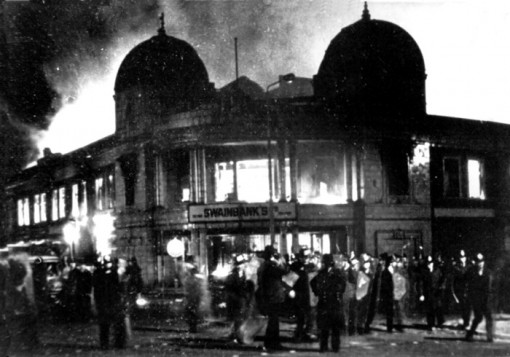
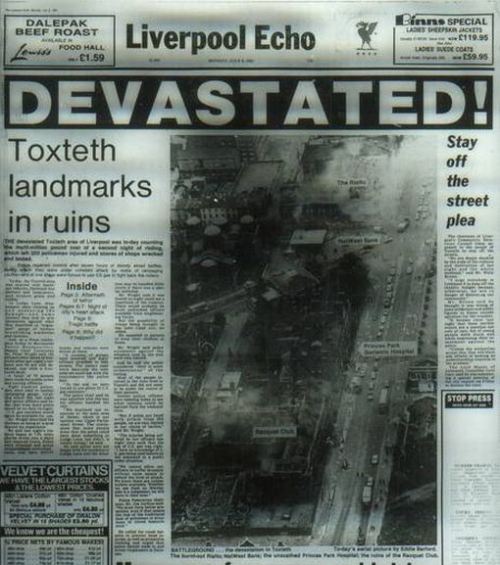
The second piece was an eye-witness recollection by Gerry on his blog, That’s How the Light Gets In , from which I’ve pinched a couple of photos. He recalls,
At the time my job was organising adult and community education courses in a local college. One of the projects with which I was involved at the time was a course initiated by South Liverpool Personnel, an adult education centre in the Rialto buildings. The aim of the course was to begin to rectify to the virtually zero representation of local black residents on university courses and in professions such as teaching and social work locally. The project in itself epitomised the deep social fractures that culminated in the riots. Local community activists had been warning for several years of the probable consequences of these divisions. Indeed, the 1973 Report of the Select Committee on Race Relations inquiry into educational opportunities for black people had noted that the black community in Liverpool was disadvantaged both inside and outside school. The Select Committee concluded: ‘Liverpool … left us with a profound sense of uneasiness’.
But I was brought back from history by sight of a Haringey video,
As supporters of the Campaign will know one of the most articulate and creative young people’s groups fighting the cuts has been SaveHaringey Youth Centres. In the event this video is not one of the group’s creations [as far as I can see], but involves interviews with young people on the streets. The video is preceded by the following summary- After Haringey council shuts eight of its 13 youth clubs, local teenagers fear boredom will fuel violence between young gang members on the streets of north London. The video itself ends with a young man repeating, “there’ll be riots.”
 Lewis Whyld/PA
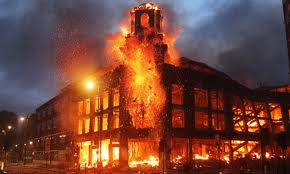
And so it has come to pass. Tottenham and elsewhere have been engulfed by a wave of anger directed at both police and property, triggered by the fatal and increasingly controversial shooting by police of 29-year-old Mark Duggan. Inevitably the young people rioting are described as ‘mindless thugs’ by the police and indeed by Diane Abbott, a local MP, even as she notes that parts of the community were a tinder box waiting to explode. Somewhat contrarily these ‘mindless’ elements are then castigated for being organised and coordinating their activities via social networking.
Other perceptions do echo the concerns of three decades ago. In London Riots : Tensions behind unrest revealed
One local university student comments,
“tensions – some racial – had been bubbling for a long time. “The police never talk to us, they ignore us, they don’t think we’re human in this area,” he said. “We get pulled over all the time like criminals. If you’re wearing a black hood, [if] you’re a black man, they pull you over for no reason.” He said Tottenham had a bad reputation for drugs, with very few prospects for jobs, but not everyone behaved like the dealers and addicts. “I’m from Tottenham, but I go to uni, I made myself good and got a job,” he said. “But if I wear like a hoody and walk in the road, they’ll just call you, check you and search you – that’s a breach of your human rights.”
He added: “I’m not happy about the rioting, but I think it was necessary so that the people will know what’s going on in this community and they’ll learn from that.
Drawing parallels and conclusions too hastily and easily will though be mistaken. From the point of view of youth work, it is seductive to point to the young people’s concerns about youth centre closures and the ensuing unrest. There is a sense here in which the disappearance of the youth centre is a metaphor for the the disappearance of hope and optimism about the future, the growing lack of opportunity and choice. Of course it would be great to see the youth service cuts restored, but this must go hand in hand with a profound change of political direction in which ordinary folk, young and old, begin to take direct control over the issues effecting their lives. It is necessary too to think afresh about the way in which these riots are unfolding. 2011 is not the same as 1981. The Toxteth uprising [as we preferred to call it] came at the beginning of the neo-liberal era of ‘possessive individualism’. Is it romantic to suggest it retained a collective character rooted in a tradition of solidarity? The groups of young people coordinating the looting or liberating of plasma TV’s, mobiles and designer shoes are the children of neo-liberalism’s fetish of conspicuous consumption and its abandonment of of values and ethics – witness the corruption of political life, the utter mediocrity of our so-called leaders and the obscenity of speculative casino capitalism. The young people are not at all mindless, but what is exactly going through their minds? I suspect the reasons behind this outburst will prove complex. But if Martin Luther King was right to argue that ‘riots are the voices of the unheard’ we need to be listening to young people in their unity and diversity. I hope that youth workers and young people will let us know what they think is going on.
TT


As one of the authors of Liverpool ’81: Remembering the Riots, I want to praise Tony’s excellent piece here, and also to say that one of the things that jumped out to me when researching the book was how important youth clubs were to young people in the area. The Methodist Youth club, in particular, was a lifeline for young people who on the one hand were forced to grow up early (seeing and experiencing things no 13 year olds should have to) and on the other were unable to experience the privileges of adulthood (such as employment). Many young people in Liverpool 8/Toxteth in 1981, from their early teens to their twenties, relied on that youth club and benefited from it. I admire the people who run organisations like this, and feel that their funding should be assured; it’s the least the rest of us can do.
[…] campaign covered the August 2012 events from the outset in Riots are the Voice of the Unheard, which spoke too of Toxteth 1981, in Views from the Street, within which Tania, a youth worker on […]